AI Tool Suite and Governance Framework – Enterprise Internal Deployment
AI tool suite, governance framework, adoption program, and outcome measurement — built and maintained in production
Project Snapshot
- Client: QAT Global (internal enterprise deployment)
- Organization Size: $40M+ annual revenue
- Teams: U.S. and Brazil
- Deployment Start: 2021
- Status: Active — maintained through 2025
- Tools Built: 10 integrated production tools
- Model Generations Maintained Through: Four years of quarterly updates
Frameworks Used
- The 7 Failure Points Audit
- The 5 Governance Decisions
- The 3 Pre-Deployment Questions
- Role-Based Adoption Training
- Quarterly Maintenance Protocol
Key Results
- 30% productivity improvement
- 40% reduction in manual production time
- 33% reduction in attribution errors
- Zero governance incidents
- Four years of continuous operation
- Three countries, one operating standard
Technology Stack
- ChatGPT (Custom GPTs and API)
- Claude (Claude Projects and API)
- OpenAI API via Gravity Forms
- Copilot (Microsoft 365 integration)
- Zapier (workflow automation)
- WordPress (portal integration)
- HubSpot (CRM and lifecycle)
- GA4 + Looker Studio (measurement)
The Situation
QAT Global is a $40M+ custom software development and IT staffing firm with teams across the U.S., Brazil, and Costa Rica. In 2021, there was no AI strategy, no AI budget, no dedicated AI team, and no governance framework in place. The marketing function was producing high volumes of work manually. The competitive environment was beginning to shift toward AI-enabled workflows, but the organization had not made a formal commitment to AI adoption.
Marketing was responsible for demand generation, content production, sales enablement, brand management, platform development, and team training across a growing international operation. The volume was sustainable but not efficient, and efficiency was about to matter more as AI-enabled competitors began moving faster.
The Challenge
Building a production AI program inside a live enterprise without executive mandate, dedicated resources, or an existing framework. Every governance decision, tool selection, workflow integration, and team training program had to be designed, tested, and implemented alongside ongoing full-scale marketing operations.
Three specific problems needed solving simultaneously. The first was productivity: the team was capable but the work was manual and the volume was growing. The second was governance: AI tools were already accessible to individual team members, which meant individual judgment calls were being made every day about what data went into which tools, with no written policy guiding those decisions. The third was durability: any system built on AI tooling in 2021 had to survive quarterly model changes, capability shifts, and the inevitable churn that comes with fast-moving technology.
What Was Built
AI Tool Suite — 10 Integrated Production Tools
Each tool was built on real company knowledge rather than generic model outputs, grounded in actual workflows, client data structures, and brand standards. The tools were integrated into existing platforms — WordPress, Gravity Forms, the QAT Global Employee Portal, and the Client Portal — so adoption happened inside systems the team already used.
- AI Resume Builder — automated candidate resume formatting for open roles, reducing turnaround time for talent acquisition from hours to minutes
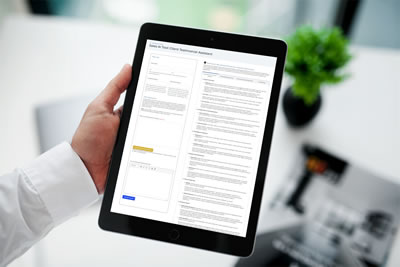
- Testimonial Assistant — guided testimonial generation for employees and clients, integrated into both portals via Gravity Forms and the OpenAI API
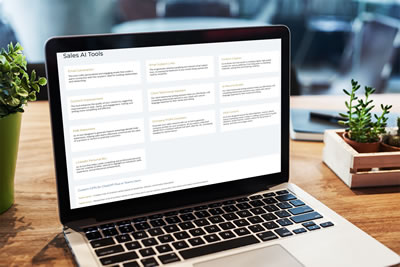
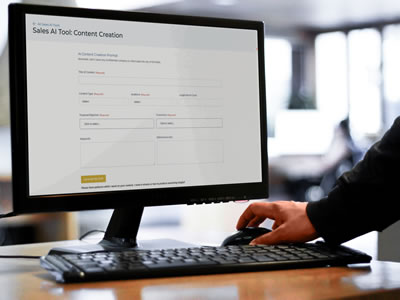
- Sales AI Tools Suite — four tools supporting the business development function including prospect research, outreach drafting, proposal support, and competitive positioning
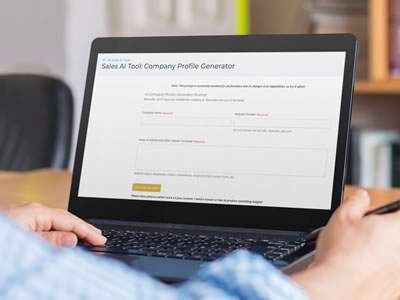
- Company Profile Generator — automated company research for sales and marketing, grounded in structured prompts aligned to QAT’s Ideal Customer Profile
- Content Improvement Tool — editorial review and rewrite assistant for marketing content, trained on brand voice standards
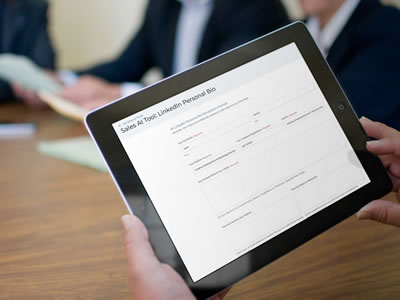
- LinkedIn Personal Bio Generator — employee-facing tool for professional profile development, reducing dependence on marketing for individual requests
- Content Creation Assistant — structured content drafting for campaigns, blog posts, and sales materials with brand and compliance guardrails built in
- Custom GPTs — specialized agents for product naming, trademark research, and data analysis, built in ChatGPT and Claude
AI Governance Framework
Governance was built before deployment, not after an incident. The framework covered five explicit decisions that most organizations skip: data handling standards by sensitivity tier, consent management for client-facing and employee-facing workflows, human-in-the-loop design for each workflow type, access control by role and function, and output review standards by content category.
Written policies were created in language employees could actually use, not legal frameworks they would route around. The consent management component included review by legal counsel before deployment of any tool touching client or candidate data.
Adoption Program
Training was designed by role, not by tool. Rather than teaching team members how to use each individual application, the training built a mental model for AI-assisted work: what types of tasks AI handles well, where human judgment is required, how to evaluate output quality, and what to do when a tool produces an unexpected result.
Teams across the U.S. and Brazil received role-specific training. The goal was institutional capability, not individual dependency. Any team member trained under the program could operate independently, train a new colleague, and identify when a workflow needed updating as model capabilities shifted.
Measurement and Maintenance System
Baselines were established before deployment for each AI-enabled workflow. Productivity was measured against those baselines at 30, 60, and 90 days. Output quality was reviewed by a senior team member for the first 90 days of each new tool’s deployment. The measurement system tracked real outcomes, not activity: time saved per task, error rate reduction, and whether outputs required heavy editing before use.
A maintenance protocol was established at the start rather than as a reaction to problems. Prompts were reviewed quarterly. Tool performance was reassessed when model updates were announced. Workflows were rebuilt when capability shifts made the original design obsolete. This protocol is the reason the system has survived four years of continuous model evolution.
The Results
- 30% productivity improvement across AI-enabled marketing workflows, measured against pre-deployment baselines
- 40% reduction in manual production time on core marketing deliverables including content, sales enablement materials, and reporting
- 33% reduction in attribution errors through AI-enabled workflow automation and GA4 rebuild
- Zero governance incidents across the four-year deployment period
- Three countries, one operating standard — U.S. and Brazil teams trained and independently operational under the same governance framework
- Four years of continuous operation through quarterly model changes, capability shifts, and platform updates without capability regression
- The testimonial assistant, resume builder, and sales tools suite are still in active production use and have been updated through multiple model generations
What Made It Work
Three decisions made the difference between a program that sustained and one that would have stalled.
The first was building governance before deployment rather than after an incident. When every employee is making individual judgment calls about what goes into AI tools, the exposure accumulates quietly. Writing the policy first — and making it usable, not just compliant — meant the team had a framework to work within rather than a restriction to route around.
The second was training for mental models rather than tool features. Teams that understand why AI works the way it does make better decisions about when to use it and how to evaluate its outputs. Teams trained only on tool mechanics become dependent on specific tools and struggle when those tools change.
The third was treating maintenance as a designed system rather than an ad hoc response. AI implementation that does not include a maintenance protocol will degrade as models update. Building the protocol at the start, with clear triggers for review and clear ownership of updates, is the reason the program is still operating four years later.
“Big shoutout for your fantastic work on the AI Testimonial Generator and Gravity Forms integration. That tool will be a game-changer for client engagement. You rock.”
— Tayler Solis, Product and Marketing Team, QAT Global